
Crafting Record Sealing Policy in Over 30 States
We’ve worked with over 30 states, including Colorado, Oklahoma, and Michigan to design and help pass human-centered record sealing policies
Impact
- We’ve worked with advocates and governments in over 30 states, including Colorado, Oklahoma, and Michigan, to build automatic record sealing policies that integrate technical expertise and best practices into the law before it gets passed, ensuring a policy is more likely to be passed and can be implemented effectively when it goes into effect.
- We take into account government’s technology and data availability to help surface and solve implementation problems before they happen.
The challenge
A criminal record can be a lifetime barrier to housing, education opportunities, and career advancement. Traditional record sealing laws rely on petition-based processes, which essentially require someone to have a legal degree or hire legal help.
These types of processes are costly for individuals and time-consuming for people working in state governments who have to manually seal records submitted for expungement. Less than 10% of eligible people actually seal their records through petition-based systems—in other words, these systems leave 90% of eligible people behind.
We know there’s a better way. With automatic record sealing—also known as “Clean Slate laws”—people’s records are sealed automatically by their government, as soon as they’re eligible under the law. States across the country are now passing laws that make this a reality. But, we don’t want to pass just any law – a policy is only successful if it’s designed in a way that prioritizes effective technical implementation. That’s where we come in.
Our approach
In our work with state agencies, lawmakers, and policy advocates, we’ve seen what works and what doesn’t. We help during the policy design phase to craft a policy that government agencies can successfully implement once it’s passed. Alongside the people doing this work day-in and day-out, we surface and solve for data management challenges, technical constraints, and business process concerns to make sure that everyone is prepared to make the shift to automatic record sealing—because we know a policy won’t work unless the people responsible for implementing it are confident in their ability to do so.
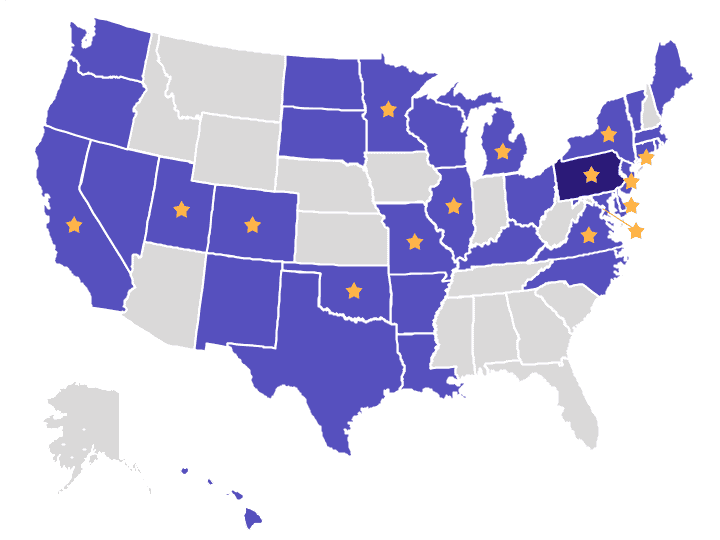
Automatic record sealing landscape
States where Code for America has advised on either policy and/or implementation
Other states with automatic record sealing policies
Automatic record sealing policy passed
When working with states to craft policy, we focus on two things:
- Integrating technical best practices in new policies: We’ve developed technical best practices for Clean Slate legislation and we incorporate these into early drafts of automatic record sealing legislation.
- Designing policy solutions that take into account government technology and data availability: Criminal legal system agencies use a wide variety of systems to keep criminal records, and the data in them is often piecemeal and outdated—but that doesn’t mean it can’t be the foundation of a working automatic record sealing process. We work with government agencies to learn how their systems work, where relevant data “lives,” and how systems interact with each other. We then use this information to help design policies that can work in the real world.
Throughout the process, we review proposed bills for technical implementation challenges, evaluate external stakeholders’ feedback about the bill, create talking points for how to discuss technical aspects of the automatic record sealing policy, and provide demos to government agencies showing technical solutions to possible implementation challenges.
Our goal is to ensure that Clean Slate laws are effective and make government easier to navigate for as many people as possible. A record sealing policy—even if it’s automatic—won’t do much good if its eligibility is narrow or its process is so complex that government agencies can’t implement it on a meaningful timeline. A good record sealing policy fulfills the promises set out in legislation.
Outcomes
We started this work in California, where our record sealing pilot that began with five counties grew to eventually help counties statewide facilitate the reduction, dismissal, or sealing of 144,000 cannabis convictions. Since then, we’ve worked with over 30 other states to help pass technically feasible policies that will remove barriers to opportunity for millions of people.
With the right policies and the mindful use of technology, government can deliver this kind of impact at the scale we need to meet the moment. Every state that successfully proves that this can be done sets an example for more states to follow.
Read more

Let’s work together to improve government in meaningful ways