
Designing an Easy Online Application for Child Care Assistance
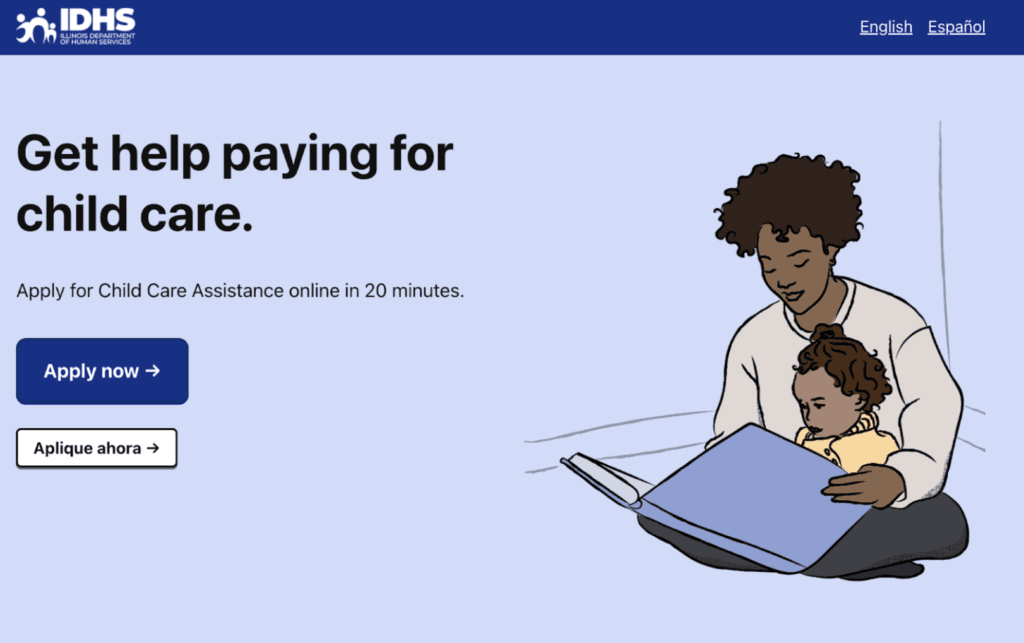
We worked with Illinois to build an online application for child care assistance that takes into account the needs of families, providers, and caseworkers
Impact
- We helped Illinois convert a 17-page PDF form for child care assistance into an easy-to-use online application.
- We reduced the time it takes to apply from several hours to an average of 17 minutes. In addition, 68% of people were able to complete the application.
- 93% of families and 96% of providers rate the new online application as “easy” or “very easy” to use.
The challenge
The Child Care Assistance Program (CCAP) is a federal-state program that provides financial assistance to parents and other caregivers with low incomes to pay for child care so that they can work or attend school. Families in Illinois used to have to fill out a 17-page PDF form in order to access CCAP. After they’d filled out the form, they then had to either find a fax machine to send it in, or take it in person to a local office. The form presented a lot of problems. It was not accessible to people who rely on assistive technologies, and couldn’t be opened on a mobile phone—which is how many people with low income access the internet. When we conducted research with clients, we couldn’t find a single family that was able to complete the form without assistance. The opportunity was clear: Illinois needed a simple, accessible form designed to ease the burden on families, childcare providers, and state workers processing the applications.
Our approach
To begin the process of transforming the paper application into an online portal, we first had to breakdown the form into its component parts: the family application and the childcare provider response. Our initial pilot focused only on the family application. We launched with a small group of pilot providers and manually concierged the provider part of the process.
With the paper application, the family and provider sections of the application were combined on one paper form, and applicants had to physically meet their provider to complete the application. When we created the web application, we made it so that the two sections are distinct but connected. Families had the flexibility to start an application on any device and then notify their provider to complete their part.
After the launch of the full application product, the provider response rate was 33%, much lower than our target of 75%. The low response rate would cause huge problems for the workers who process CCAP applications and would prevent us from rolling out the application statewide. To figure out why the response was low, we took a multi-pronged research approach:
- Mixed method investigation: We combined qualitative and quantitative research to uncover the problem areas.
- Shadowing users: We observed actual application attempts in real-time, and were able to catch problematic interactions and understand user expectations.
- Analyzing data: We created funnels and analyzed analytics for family and provider flows.
We found three main areas for improvement:
- Drop off: Families were leaving the process before sending their application to their provider.
- Failing mailto links: Mailto links weren’t working on many devices, and families expected that the site would message their provider for them.
- Barriers for providers: Many providers didn’t know their provider ID number, which was required for them to respond.
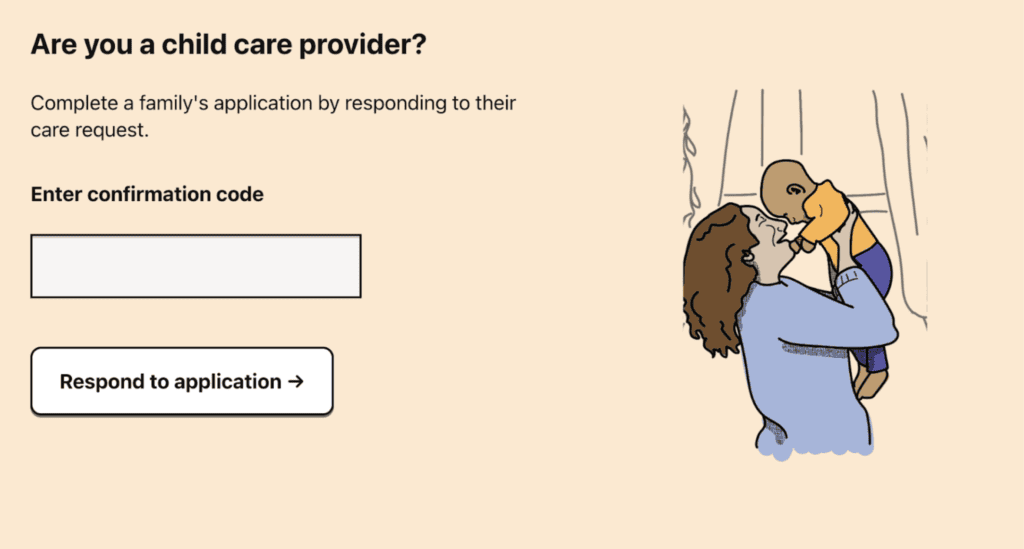
We worked in conjunction with the Illinois Department of Human Services and the Illinois Department of Innovation and Technology to solve these problems. When we investigated the sources of drop off, we found that the document upload process was creating a roadblock before families got in touch with providers, so we restructured the family flow to move provider messaging before document upload. When we looked into the silent email failures, we realized that families believed we were sending emails on their behalf, so we replaced mailto links with server-sent emails to match user assumptions. To deal with the fact that providers were struggling at the point where they had to provide their ID numbers, we offered alternate verification flows, enabling providers to add their FEIN instead. The result was that our provider response rate jumped from 33% to 75%, a massive win for families and the state.
Outcomes
We’ve transformed a difficult paper process into an online experience that families and providers love. Now families can apply for CCAP on a computer or phone, whenever and wherever it is convenient for them. The online application takes an average of 17 minutes to complete, down from hours. The online application is fully accessible and available in both English and Spanish. The site has processed more than 12,000 applications so far, averaging around 500 applications per week, and we’re in the process of rolling out the online application statewide.
This work has been a great example of some of the core principles of Code for America’s approach:
- The application was built in an agile and iterative way, gradually adding additional use cases to support more families and providers over time.
- We spoke to more than 100 research participants in interviews, prototype tests, and co-design sessions.
- We ultimately delivered a product that families and providers love for a much lower cost than typical government technology vendors.
We look forward to continuing our work with Illinois to make it even easier for families to get matched with childcare providers who suit their needs.

Let’s work together to improve government in meaningful ways