Streamlining the Disaster Recovery Process with Los Angeles
Code for America partnered with Los Angeles County in the wake of the 2025 wildfires to streamline the rebuilding process for survivors
Impact
- We sent a nimble team to LA to shadow planners at a Disaster Recovery Center, talk to wildfire survivors and staff, and gather information about the complex process involved in disaster recovery.
- We created a service blueprint that mapped the full survivor journey—from temporary housing to rebuild permitting—to help county staff from six agencies, including the fire and health departments, planning and building safety, and others, identify opportunities to improve agency hand-offs and simplify the process for survivors.
- We helped LA redesign a mobile-friendly website to help the 200,000 survivors who had lost their homes understand their options for rebuilding in the wake of wildfires.
The challenge
Over the course of 23 days in 2025, Los Angeles County experienced 14 fires. The impact was devastating: dozens of people died, more than 200,000 people were forced to evacuate, 18,000 homes and buildings were destroyed, and more than 57,000 acres of land burned. Whole neighborhoods were destroyed, like Altadena and Pacific Palisades, and many survivors had few options for places to stay.
Natural disasters like these can present major, unexpected challenges for local government infrastructure, and require prioritizing competing, urgent demands. In the wake of the LA wildfires, people urgently needed to rebuild their homes—for LA County, this meant they’d need to evaluate their building and permitting processes to ensure this could be as easy as possible for survivors. As a civic tech organization, Code for America’s question was: how could the mindful use of technology, grounded in a human-centered design framework, bring clarity and simplify the permitting process for both county workers and survivors looking to rebuild?
Our approach
After the devastating wildfires in LA County, Code for America quickly deployed a rapid response team tasked with determining technical ways to ease the administrative process for survivor rebuilding. We used a small team with a diverse set of skills, including a solutions architect, two UX designers, and a content designer. Our work was divided in three phases: discovery, service blueprinting, and website redesign.
In the discovery phase, we set out to develop contextual understanding of survivor and stakeholder needs. We attended biweekly standups with the LA County CEO’s office, Department of Regional Planning, Public Works, Public Health, and the Fire Department; shadowed county workers at a Disaster Recovery Center, observing six intakes and talking with three wildfire survivors; and conducted eight staff interviews with stakeholders. This phase provided critical information and relationships that informed how we approached our second phase of engagement.
During service blueprinting, we worked with the county to collaboratively map the permitting process, so we could build a shared understanding of pain points and opportunities of the service. This helped surface the needs that would arise while changing the county permitting process.
Survivors would need:
- Quick access to permits and support for interim housing
- Streamlined access to the permitting process across county departments
- Clear and plain language communications about the rebuilding processes
County departments would need:
- Effective cross-agency collaboration around processing permits and collecting fees
- A balance between removing administrative burden and ensuring safety
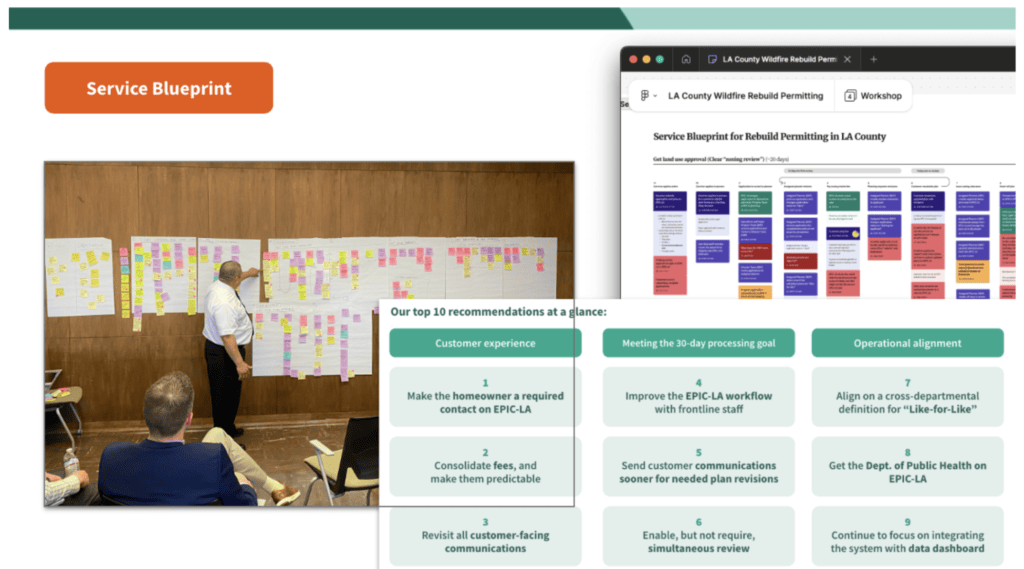
After we built a service blueprint, we had the knowledge needed to move onto the website redesign of the LA Recovers website. Our redesign was focused on improving usability, accessibility, and responsiveness. The goal was to help survivors easily understand what steps they would need to take, as well as reduce the questions that workers needed to answer from survivors about the process. The hope was for this to serve as the basis for improvements for current and future emergencies, so that workers had capacity to process more requests in the future and survivors felt less overwhelmed.
We built a WordPress theme with new, reusable components, in parallel with the LA County team’s current website, that they could quickly use in their test environment and then deploy when they were ready. These components included things like in-page navigation to help users navigate between blocks of information quickly and accordions that progressively reveal information users need, without overwhelming them.
We then user tested and conducted an audit of the website, looking at site traffic patterns, common user paths, and content with overlapping information or titles. Throughout the process, we worked side by side with county staff to develop content, design, and technical guides so the site could be nimble and easily changed in response to future needs.
Outcomes
Our work with Los Angeles proved that government can be future-thinking while responding to immediate crises. Together, we worked to not only improve the online search experience for survivors, but also set the team up for success to improve their tech-enabled services over time. During our work with the county, we produced several key resources, including:
- A service blueprint that mapped the full survivor journey—from temporary housing to rebuild permitting—to help county staff from six departments identify opportunities to improve agency hand-offs and simplify the process for survivors
- A county-wide banner that got deployed across all county websites, from emergency and public health services to public works pages, which allowed survivors to get the latest information and directed them to the recovery.lacounty.gov website
- A redesigned, mobile-friendly website to enable survivors to understand their options and make informed decisions about what actions to take, which LA County launched at the beginning of 2026
- User-centered and UX-tested content, design, and engineering guidance, along with training, so county staff could maintain and improve the site over time
The county is using the information architecture templates and processes that we recommended to ease navigation for survivors even as new disasters unfold and happen in parallel. We recommended that every new disaster that moves to the recovery phase have its own dedicated page to avoid displacing important past or ongoing recovery information for other disasters.
We can’t predict when the next wildfire or other natural disaster will strike, but Los Angeles is now more prepared to coordinate across agencies, be responsive to client needs, and adapt their digital front doors to be more accessible. That’s a government responsibly applying technology to improve outcomes for everyone.
Let’s work together to improve government in meaningful ways