- News and Stories
- Blog post
- Summit
What We Saw in Chicago: Hope, Technology, and the Future We’re Building
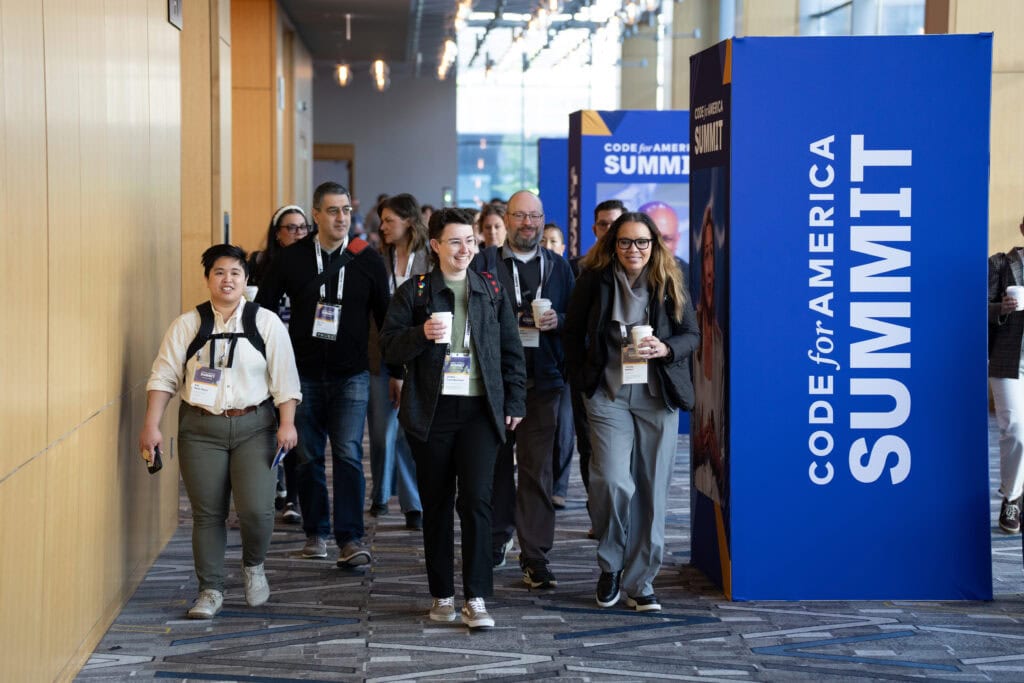
This year’s Code for America Summit felt different.
We gathered in Chicago, for the first time and with hundreds of new attendees, at a time when trust in government is fragile, public servants are being asked to do more with less, and millions of people are dealing with the uncertainty that comes when systems don’t work as they should.
And yet, with every mainstage conversation, breakout session, hallway exchange, and demo, I couldn’t help but feel inspired.
Inspired by the work to make systems better. Inspired by the people sharing what they’ve learned. Inspired by the meaningful improvements being made in people’s lives.
It was evident during one of the lightning talks, where we witnessed a truly unforgettable Hamilton-style rap on how to improve the relationship between contractors and government. (We really hope you didn’t miss that one!)
It was evident when former U.S. Transportation Secretary Pete Buttigieg joined mainstage and challenged attendees to build for the future, stating, “The project is to build institutions that are actually going to work for us for the rest of our lives. Things are not going back to the way they used to be.”
And it was evident during so many eye-opening talks. Our panel on the future of the safety net bonded over the belief that this work is not just about fixing broken systems, but about building entirely new systems that are truly adaptable and human. Dr. Rahul Vanjani, a physician and founder of ITO Health, called for systems designed to support the clinicians who are on the front lines of Medicaid access so they can serve as guides and connectors, not as gatekeepers. And our first-ever philanthropy discussion brought to light the power of partnership when civic tech initiatives are able to have the space and resources needed to maximize technology tools for good.
This year, we intentionally gathered in the middle of the country to focus on bridge-building and connection and we left feeling more clear-eyed and hopeful about the future we are building, together.
During one breakout session, Arizona demonstrated how they’re using AI to translate SNAP communications from complex jargon into accessible plain language in English and Spanish. In the Demo Lab, engineers from Pennsylvania showed off TrackMyBenefits.pa.gov, a system built and deployed in eight weeks to let residents check their benefit status without needing to log in. These are exactly the kind of forward-thinking projects that allow us to learn from one another and inspire collaboration to drive innovation forward.
We also made some exciting announcements about Code for America. We introduced our new CTO, Jonathan Porat, and announced the launch of our partnership with Anthropic to design and deploy Claude-based tools to help government caseworkers more efficiently administer SNAP benefits. The live demo showcased the tool’s ability to pull accurate, to-the-date policy information so that caseworkers can feel confident in helping clients while saving magnitudes of time for everyone involved.
And one of our favorite sessions of the entire event was learning about the ‘science of hope’ with Dr. Chan Hellman, a professor at the University of Oklahoma and the director of the Hope Research Center. Dr. Hellman expanded our thinking around how hope is a necessary building block to creating meaningful change.
Hope is the expectation we have of the future that is possible.
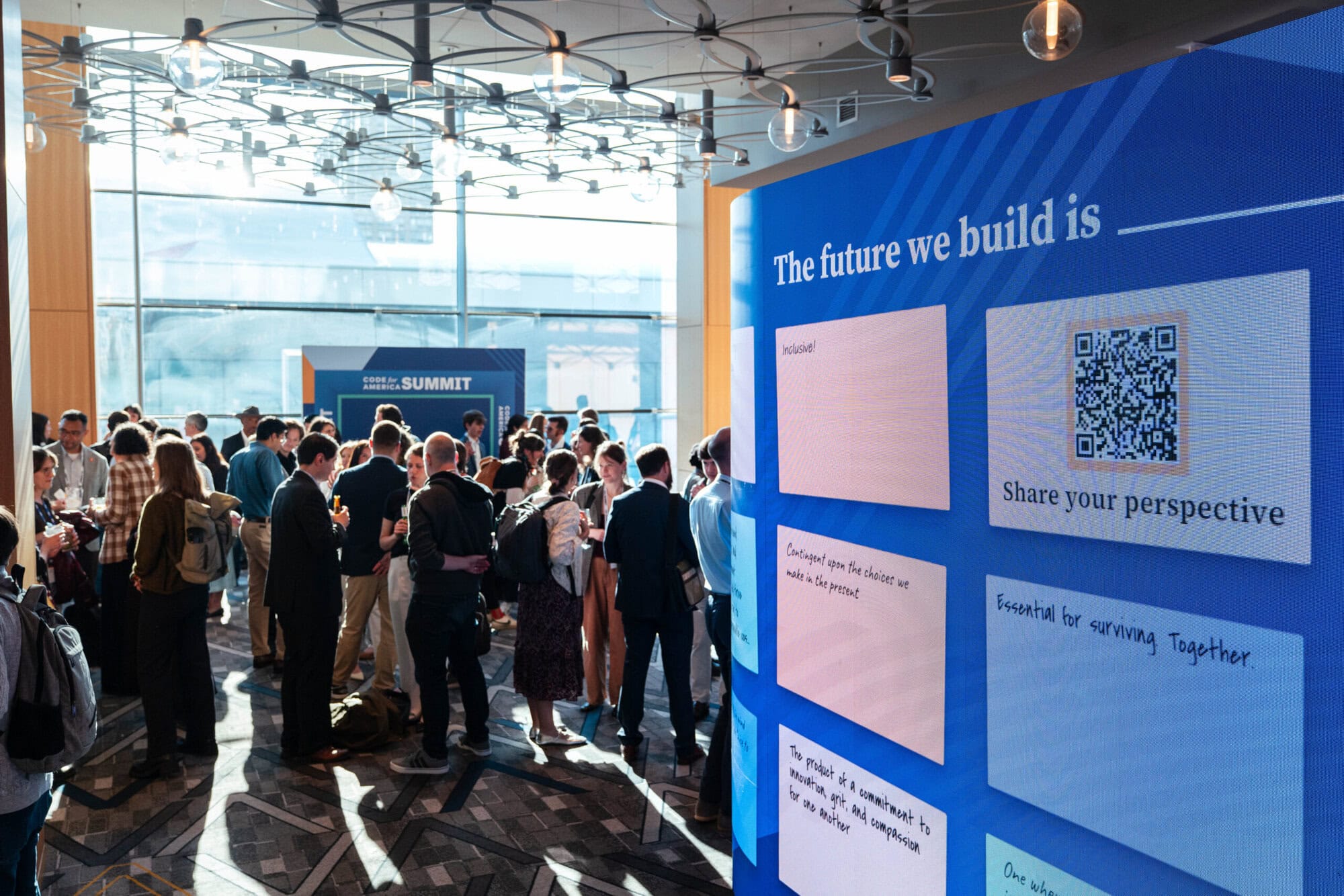
This sentiment was also echoed through the Summit 2026 interactive installation which attendees used to answer the prompt: The future we build is…one that has HOPE. one that is powered by a belief that the future can be better, and in which we have power to make it so.
As I stood on the Summit stage, just as I have for the last six years, I saw something that doesn’t show up in any dataset: a room full of people who refuse to give up on government. Public servants, technologists, advocates, funders, designers, researchers, community leaders. All of them there because they believe a better system is possible, and because they’re willing to do the work to prove it.
That’s what Chicago gave us this year.
Thank you to everyone who showed up, shared what you know, and left ready to build. What happened in Chicago belongs to all of us. So does what comes next.
Missed Summit this year? Recordings from mainstage will be available on our YouTube channel soon. Sign up to be notified.